

Choosing hydrating skincare products gets easier when you focus on the job you want each product to do. “Hydrating” and “moisturizing” often appear side by side, while serums, creams, and other formats can make a simple routine feel harder to navigate.
Hydration and moisturization are related, but they don’t always describe the same role. A light serum can feel different from a cream, and texture matters when deciding what you’ll use consistently. You don’t need a crowded shelf or a complicated ingredient checklist to get started.
This guide explains what hydration-focused products are for, how their roles differ, and how to choose formats that suit your preferences and routine. It also offers a simple starting point, without promising guaranteed results. My Big Market’s The hydration collection is a place to explore hydration-focused skincare with a preference for simplicity and caring ingredients.
Key Takeaways
- Consider the role of hydrating skincare products when deciding what may fit your routine.
- Compare cleansers, serums, moisturizers, and face mists by their typical purpose, not just their format.
- Choose a texture and routine you’re comfortable using, then follow the product directions.
- Read ingredient labels and look beyond broad marketing terms when comparing options.
- Explore The hydration collection as a simple starting point for hydration-focused skincare.
What Hydrating Skincare Products Do for Your Skin
Hydration-focused skincare supports the skin’s water content and everyday comfort. It may suit a routine for skin that feels tight or less comfortable, though what feels right varies from person to person.
Hydrating skincare products are used to support the skin’s water content and help it feel comfortable as part of an everyday routine. That’s the basic idea. The goal isn’t to use every product labeled “hydrating” or to expect the same experience from each one. A product’s role, texture, and place in your routine all matter.
Hydration and moisturization are closely connected, but describe different functions. Hydration focuses on water content; moisturization helps limit moisture loss. Some products may support both, while others are chosen for one role. The Moisturizer Wikipedia article offers a broader overview of moisturizers and their use in skincare.
Hydration and moisturization are not the same thing
Think of hydration as the water-related part of skincare. Moisturization is about caring for the skin in a way that helps reduce moisture escaping from its surface. The terms often appear together, but they aren’t interchangeable. One product doesn’t have to do both jobs. The right balance depends on what you want a product to do and how it fits your routine.
What hydrated skin may feel like
Skin that feels more comfortable or less tight may be a sign that your routine suits it. These are possible experiences, not guaranteed results. Your skin’s feel and appearance can shift with your personal skin, surroundings, and the products you use. A dry-feeling day doesn’t, by itself, explain why your skin feels that way or point to a particular treatment.
Keep the goal practical. Choose products for the role you want them to play, then notice how your skin feels as you use them according to their directions. If a product feels uncomfortable or doesn’t suit your routine, that’s useful information for your next choice. Hydration isn’t a promise of a particular look or sensation. It’s one part of caring for your skin in a manageable way.
How Hydrating Skincare Products Support Moisture Balance
Moisture balance depends on more than one product function. Some ingredients are associated with attracting or holding water in the skin’s outer layers. Other ingredients and product types help soften the surface or reduce moisture loss. These roles can complement one another, but they aren’t identical. You don’t need a separate product for every role.
Water-binding ingredients help draw or hold water, while moisture-sealing product roles help reduce how much water escapes from the skin’s surface. This distinction can help you understand product descriptions without treating any ingredient as a promise. The feel and fit of a formula matter, too.
Water-binding ingredients in simple terms
Humectants are ingredients associated with attracting or holding water. Hyaluronic acid and glycerin are familiar examples. Their presence can help explain a product’s intended role, but doesn’t guarantee a particular result for every person or formula. When comparing labels, notice whether a product is described as supporting hydration, then consider how it fits your routine. A dedicated ingredient guide can explore these ingredients in more detail.
The skin barrier and moisture loss
The skin barrier is the protective outer layer of skin. One of its everyday roles is helping limit moisture loss. Emollients and occlusives describe product roles that differ from water-binding: emollients help soften the skin’s surface, while occlusives form a covering that can help slow water loss. A formula may include different kinds of ingredients, but the label and directions are the best starting points for understanding its intended use.
These roles describe support, not treatment. A cosmetic product may help skin feel more comfortable, but shouldn’t be assumed to change the skin barrier in a guaranteed way. For general dry-skin care guidance, the American Academy of Dermatology Association tips for dry skin provide advice from dermatology experts.
In practice, one product may add a water-binding step, while another may provide a softer, more protective feel. You may prefer a light layer, a richer texture, or fewer steps. Follow each product’s directions and notice what feels comfortable in your routine. Hydrating skincare products can support different parts of moisture care, so focus on the role you want rather than collecting every format or ingredient name.
For a simple place to browse hydration-focused options, explore The hydration collection.
Hydrating Skincare Product Formats: What Each One Is For
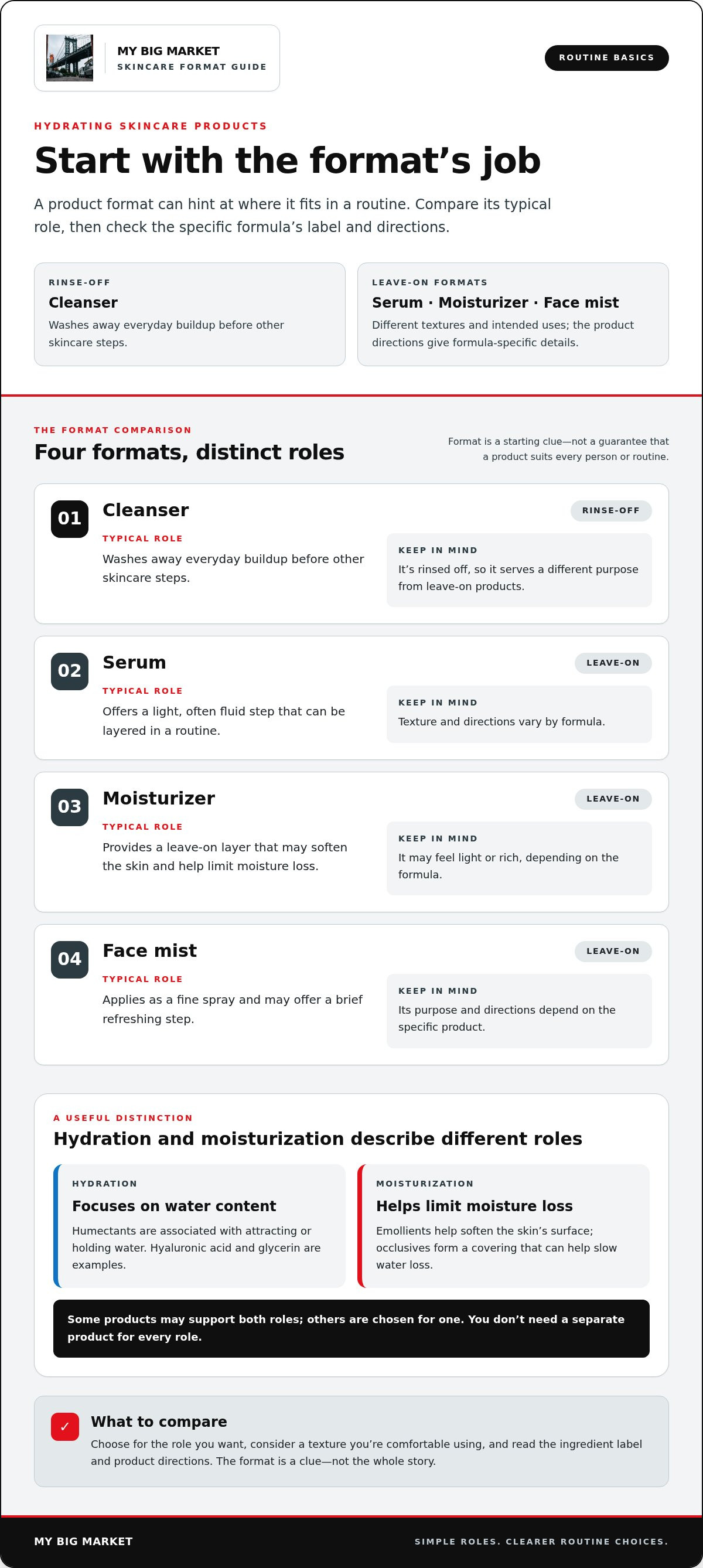
A product’s format gives you a first clue about its place in a routine, not a complete picture of what it will do. Cleansers are rinsed off. Serums, moisturizers, and face mists are leave-on formats, but their textures and intended uses differ. Use this comparison as a guide, then read the product label and directions for details specific to that formula.
| Format | Typical role | What to consider |
|---|---|---|
| Cleanser | Washes away everyday buildup before other skincare steps. | It’s rinsed off, so it serves a different purpose from leave-on products. |
| Serum | Offers a light, often fluid step that can be layered in a routine. | Texture and directions vary by formula. |
| Moisturizer | Provides a leave-on layer that may soften the skin and help limit moisture loss. | It may feel light or rich, depending on the formula. |
| Face mist | Applies as a fine spray and may offer a brief refreshing step. | Its purpose and directions depend on the specific product. |
A product’s format can suggest its usual role, but format alone can’t tell you whether it will suit every person or routine. A serum isn’t automatically better than a cream, and a face mist doesn’t replace every other leave-on step. The formula, directions, and feel on your skin matter more than the format name alone.
Serums, moisturizers, and face mists
Serums are often chosen for a lightweight layer, moisturizers for a more lasting, comfortable finish, and face mists for a quick spray-on step. These are broad descriptions, not strict rules. Formulas within the same format can feel and function differently. A dedicated hydration ingredients guide can help compare specific ingredients and labels in more detail.
For another perspective on dry skin and its care, DermNet NZ information on dry skin provides an overview of causes and management. A resource like this can help explain why one format won’t be the right choice for everyone.
When a simple routine may be enough
A basic routine might include a cleanser and one leave-on product that suits your preferences. You might choose a serum or prefer a moisturizer. You don’t need to add a mist or use every format just because it exists. Let your comfort, routine habits, and product directions guide your choice instead of following a fixed step count.
Start by deciding what role you want a product to play, then consider whether its texture fits your day-to-day routine. If you want a step-by-step approach to building fewer, more intentional steps, a minimalist routine guide can take you through that process. The goal is a routine that feels clear and manageable, not a shelf full of formats.
How to Choose Hydrating Skincare Products Without Overcomplicating Your Routine
Choosing hydrating skincare products can be simpler when you start with your current routine instead of adding several new steps at once. Think about what you want a product to do, which textures you enjoy, and how much time you want to spend on skincare. A light layer you’ll use as directed may suit you better than a complicated routine that feels hard to maintain.
Try this short decision sequence:
- Name the gap. Decide whether you want a water-binding step, a moisturizer, or a cleanser that feels more comfortable in your routine.
- Choose a texture. Consider whether you prefer something light, creamy, or easy to apply. Your comfort matters.
- Read beyond the front label. Check the ingredient list and directions to understand the product’s intended role and how to use it.
Start with the role you want a product to fill
Begin with what you already use. If your routine feels complete except for one step, look for a product that fills that role instead of adding several at once. Words such as “hydrating” can be a useful starting point, but they don’t explain everything about a formula. The directions and ingredient label offer more context. More products don’t automatically mean better hydration.
Keep the first choice gentle and manageable
When trying something unfamiliar, follow its package directions. If the product provides patch-testing guidance, use it before adding the product to your routine. Introduce one new product at a time, then pay attention to how your skin feels. Changing several products together can make it harder to tell which one suits you.
Skin can feel different for many reasons. A guide to dry skin or dehydrated skin can offer more focused information, but neither label is a diagnosis. If irritation persists or you have an ongoing skin concern, speak with a qualified clinician. Pause use of a product if it causes discomfort, and follow any safety directions on its packaging.
Keep your first choice small in scope: one product, one intended role, and a routine you can follow. This also makes it easier to notice whether the texture and directions work for you. Explore The hydration collection for hydration-focused skincare from a simplified approach centered on caring ingredients.
A Simple Starting Point: Explore The hydration collection
Once you know the role and feel you prefer, a focused place to browse can make choosing more manageable. My Big Market’s The hydration collection brings together hydration-focused skincare. The brand’s messaging centers on simplified skincare and clean, caring ingredients, without asking you to build a long routine or expect the same experience as someone else.
Explore hydration-focused skincare at your own pace
Take time with each product description. Look for its intended role, how it’s meant to be used, and directions that help you decide whether it fits your existing routine. If you’re comparing options, keep your preferences in view. A texture you enjoy and a step you can comfortably maintain may matter more than a broad label or a long list of claims.
As you browse, consider a few points:
- Purpose: Does the description explain the product’s place in a skincare routine?
- Use: Are the directions practical for the way you already care for your skin?
- Ingredients: Does the ingredient information help you understand the product beyond general marketing language?
These are prompts, not a test you have to pass. Focus on the details that matter to you and leave the rest for another time. Product descriptions can help you compare options, but they can’t guarantee how a product will feel or suit every person.
Keep care uncomplicated
A useful routine doesn’t need to include every format or follow someone else’s exact steps. It can start with one choice that fits your preferences and stay simple as your needs and habits change. The aim is considered care, not a crowded shelf. Bundles are another category to browse, and the details of each option can help guide your decision.
Hydrating skincare products can play different roles. Use the guidance in this article to browse with more clarity: notice the intended purpose, read the directions, and choose according to your routine. There’s no need to hurry or add steps just because they’re available.
If a calm, hydration-focused starting point feels right, explore The hydration collection.
Choose a Gentle Next Step
Your next step doesn’t need to be a full routine overhaul. As you consider hydrating skincare products, focus on what you want from a product and what would be easy to use within your existing habits. Keep expectations open. Your routine can evolve as you learn what feels comfortable.
My Big Market’s The hydration collection offers a focused place to browse. The brand’s approach centers on simplified skincare and clean, caring ingredients. Read the product descriptions and directions, then choose at a pace that feels right. You don’t need to add something simply because it’s popular or fits a trend. Care can be personal, shaped by your preferences rather than a long list of steps.
Give yourself room to make a considered choice. A routine doesn’t have to be perfect to feel manageable, and you can adjust it as your needs and preferences change. Explore The hydration collection and take a simple next step toward skincare that fits your routine.
Frequently Asked Questions
Is a hydrating skincare product the same as a moisturizer?
No, not always. A hydrating product might be a serum or another leave-on step, while a moisturizer is a product category with its own intended role. Some formulas may support both hydration and moisturization, but the word “hydrating” alone doesn’t tell you that. Check the product description and directions to understand whether it’s meant to stand alone or fit alongside another step.
Can I use hydrating skincare products if my skin is oily?
Yes, oily skin can still feel uncomfortable or tight, and a hydrating step may suit your preferences. Consider how a product feels in your routine. You might prefer a lighter texture over a rich one, but texture names don’t guarantee how a formula will feel on your skin. Try one product at a time and follow its directions, rather than avoiding hydration based on oiliness alone.
How often should I use hydrating skincare products?
Follow the directions for each product, since use can vary by formula and format. A cleanser is rinsed off, while a leave-on product may have different instructions. Start with the label’s guidance rather than adding extra applications because your skin feels dry at a particular moment. If the directions don’t suit your routine, choose a product that’s easier for you to use as intended.
What happens if I use too many hydrating skincare products?
More layers may feel sticky, heavy, or uncomfortable, and using several new products at once can make it harder to identify what doesn’t suit you. Some people may also experience irritation from a product. If your routine starts feeling complicated, pause additions and return to familiar steps. Reintroduce products individually, following their directions, so you can better notice how each one feels.
Should I apply hydrating skincare to damp skin?
It depends on the product. Some leave-on products may direct you to apply them to slightly damp skin, while others may specify dry skin. Read the package instructions instead of assuming the same method works for every formula. If the directions allow application to damp skin, gently pat your face after cleansing so it isn’t dripping wet, then apply the product as instructed.
Can hydrating skincare products replace drinking water?
No. Skincare products are applied to the skin and can’t replace drinking fluids your body needs. Keep your usual hydration habits separate from your skincare routine. Applying extra product or drinking more water than you need isn’t a guaranteed way to change how your skin looks or feels. For questions about fluid needs related to your health, a qualified healthcare professional can offer guidance suited to you.