

Deep hydration skincare isn’t necessarily about adding more layers. If your skin still feels tight or uncomfortable despite a full routine, another product may not be the answer. Hydration claims can be hard to compare, and too many steps can make it difficult to tell what suits your skin.
Comfortable skin depends on balance. Hydrating ingredients help bring water to the skin’s outer layer, while the moisture barrier helps slow water loss and protect against everyday stressors. Harsh cleansing, frequent exfoliation, and UV exposure can affect that barrier. A simpler routine makes it easier to notice what feels supportive.
This guide explains what deep hydration means, what can affect skin comfort, and practical habits for keeping care manageable. You’ll also find a focused place to explore hydration skincare in My Big Market’s The hydration collection. Start with a few thoughtful steps rather than a complicated checklist.
Key Takeaways
- Skin hydration refers to water content, while moisturization helps skin feel soft and supports moisture retention.
- The outer skin layer helps limit water loss, including the gradual loss known as transepidermal water loss.
- Deep hydration skincare doesn’t have to mean a long routine. A temporarily soft feel alone doesn’t prove a lasting effect.
- Simple habits, such as gentle cleansing and making one change at a time, can help you assess what feels comfortable.
- My Big Market’s The hydration collection offers a focused place to explore hydration skincare within a simplified approach.
What Does Deep Hydration Skincare Mean?
Deep hydration skincare is a broad phrase for care intended to support the skin’s water balance and comfort. It isn’t a fixed technical term, so products may use it differently. The phrase alone can’t tell you how a product will feel on your skin or how long that feeling will last. Treat it as a starting point, then read the product information for a clearer sense of its purpose.
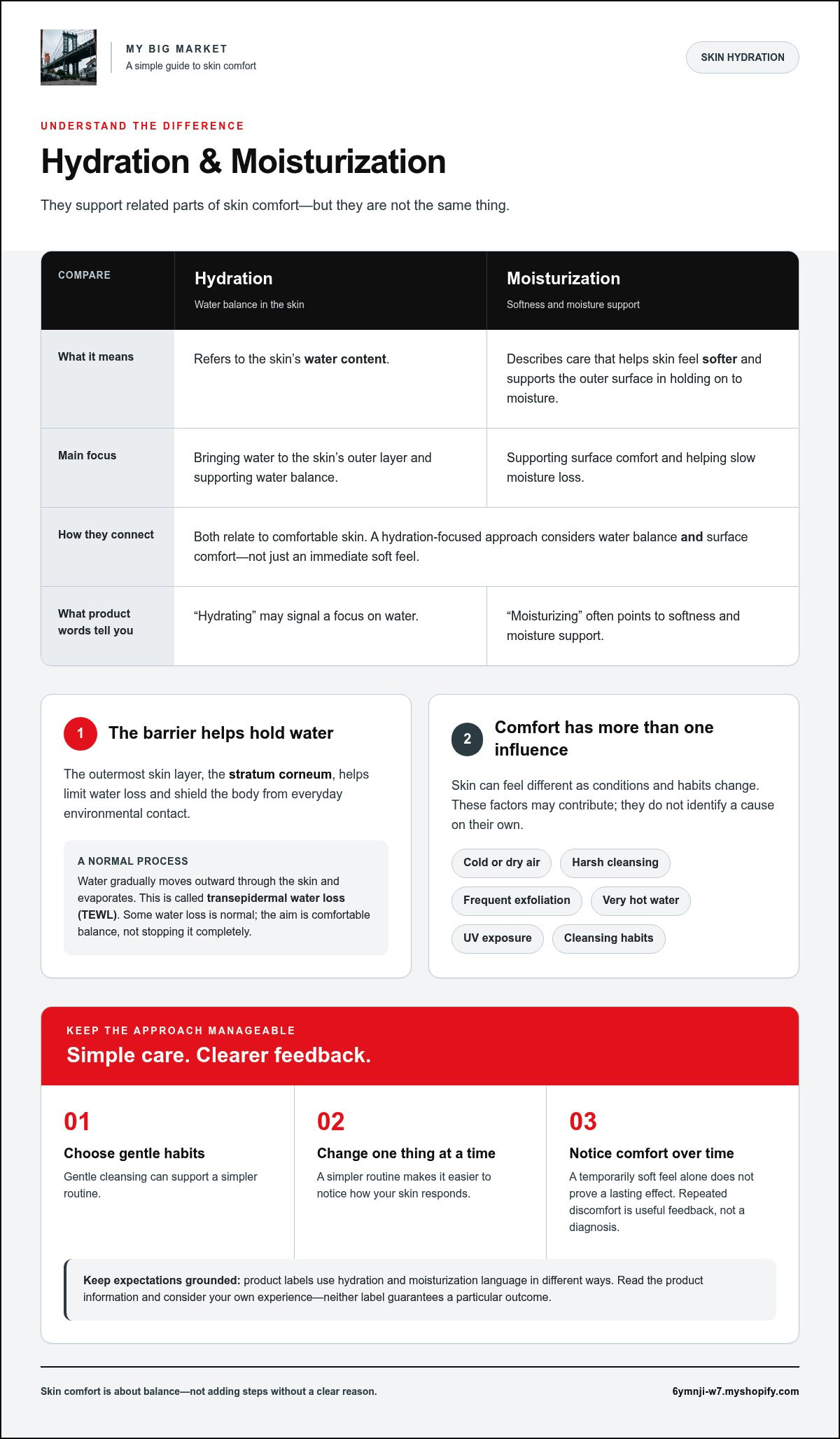
Skin hydration refers to water content in the skin. Moisturization describes care that helps skin feel softer and supports the outer surface in holding on to moisture. The ideas are connected, but not interchangeable. A hydration-focused approach considers both water balance and surface comfort, rather than treating an immediate soft feel as the whole story.
Skin can feel different from day to day. Weather, washing, and products in a routine may all affect comfort. Tightness, roughness, or flaking can have different causes, so one sensation isn’t enough to identify a skin condition. Notice when these signs appear and whether a routine leaves your skin persistently uncomfortable, but don’t treat them as a diagnosis.
How hydrated skin can feel
Some people describe comfortable skin as soft, flexible, or less tight after cleansing. Others may not notice a clear sensation. These experiences are personal: none proves a specific hydration level or points to a particular condition. Flaking and tightness can have more than one cause, and a visible glow isn’t a dependable measure. Appearance can change with lighting, skin texture, and other factors.
Pay attention to comfort over time, not only to a mirror check or the first few minutes after applying a product. If a step repeatedly leaves your skin feeling unpleasant, that’s useful feedback. It doesn’t explain the cause on its own, but it can help you decide whether to keep that step in your routine.
Hydration and moisturization are related, not identical
Think of hydration as water in the skin and moisturization as support for softness and reduced water loss. They address related parts of skin comfort, without requiring a long list of steps or a particular ingredient checklist.
This distinction also helps make sense of product language. “Hydrating” may describe a focus on water, while “moisturizing” often points to softness and moisture support. Labels use these words in different ways, though, so they aren’t guarantees of a particular outcome. Consider the wording alongside the product description, then notice how your skin feels with consistent, gentle care. Deep hydration skincare is about supporting balance, not chasing a dramatic look or adding products without a clear reason.
How the Skin Barrier Helps Hold on to Hydration
The skin barrier is the skin’s outer line of defense. Its outermost layer, the stratum corneum, helps limit water loss while shielding the body from everyday environmental contact. Think of it as a protective wall, not a perfectly sealed surface. Water gradually moves from the skin through this outer layer and evaporates. This process is called transepidermal water loss, or TEWL.
A comfortable skin barrier helps the skin retain water and feel more at ease. That’s a useful way to understand the connection, not a guarantee that a particular product or routine will change how your skin feels. Barrier support means caring for the outer layer; it doesn’t address every possible source of dryness, irritation, or discomfort.
The outer skin layer and water balance
The stratum corneum works more like a flexible protective wall than a lid. Its outer cells and surrounding natural fats help form a barrier that slows water escaping from the skin. TEWL describes that movement of water outward through the skin’s surface. Some water loss is normal. The aim isn’t to stop it completely, but to support a comfortable balance.
Water balance is shaped by more than one product or routine step. The surrounding air, cleansing habits, sun exposure, and individual differences can all play a part. A moisturizer may support surface comfort, but it doesn’t control every influence on the skin barrier.
What can make skin feel less comfortable
Skin may feel different as conditions and habits change. Cold or dry air can leave it feeling less comfortable. Frequent exfoliation, harsh cleansing, and very hot water may also be contributing factors, as can UV exposure. These are possibilities, not a way to identify the cause of an individual person’s symptoms. Tightness or redness alone doesn’t tell the whole story.
Look for patterns without jumping to conclusions. Consider whether discomfort follows a weather change, a new routine step, or more frequent cleansing. If a product or habit consistently leaves your skin uncomfortable, pause and simplify where practical. Avoid trying to compensate by adding several new steps at once. Supporting the barrier with deep hydration skincare is about steady, gentle care, not a promise to resolve every cause of discomfort.
Persistent, worsening, or concerning symptoms deserve professional medical guidance. Skincare education can explain the barrier, but it can’t diagnose a condition or replace medical advice. For a focused place to explore hydration care, browse hydration skincare options and keep your routine simple.
Deep Hydration Skincare: Common Assumptions to Reconsider
Deep hydration doesn’t automatically mean a longer routine. Adding extra steps isn’t proof that skin will feel more comfortable or retain moisture for longer. A simpler approach makes it easier to understand what you’re using and how your skin responds. Focus on clear product information and your own experience, rather than the number of bottles on a shelf.
Myth: More products always mean more hydration
Every added step brings another formula, texture, and set of directions into a routine. That may suit some people, but complexity alone doesn’t show that a routine is working better. If your skin feels uncomfortable after several changes, it can be difficult to tell which step may be contributing. More products can add effort without answering the basic question: does the routine feel comfortable and manageable?
If you want to try a change, adjust one routine element at a time. Keeping the rest of your routine steady makes it easier to notice how your skin responds. Introducing several new products together can make it hard to connect a change in comfort with any one step. There’s no universal routine everyone needs to follow. Choose care you can use thoughtfully, rather than trying to fill every possible gap.
Before adding another product, consider what you want it to do. Does its description explain its purpose in plain terms? Does it fit a need you’ve noticed, or are you reacting to a dramatic phrase? These questions can help separate useful information from pressure to keep adding.
Myth: A rich feel proves deep hydration
A creamy or silky texture can feel pleasant right away. That immediate softness is part of the experience, and personal preference matters. But the feel on application doesn’t, by itself, prove lasting hydration or a change to the skin barrier. Sensory feel and longer-term outcomes are different things.
Read claims with care. Broad phrases such as “deeply hydrating” may describe a product’s intended role, but they don’t explain exactly what to expect for every person. Be thoughtful about time-based or guaranteed promises. Look for clear descriptions rather than assuming that a rich texture, glowing finish, or emphatic wording demonstrates a lasting effect. Don’t treat a phrase alone as proof.
Approach deep hydration skincare with patience, not a race toward the most elaborate routine. Choose products for a clear reason, notice how your skin responds, and let comfort matter more than a dramatic promise.
Simple Daily Habits That Support Comfortable, Hydrated Skin
Supporting comfortable skin doesn’t have to mean adding more steps. Everyday habits can help you notice what suits your skin and what leaves it feeling unsettled. These are general practices, not a prescribed routine or product-layering order. Start with the basics, then make changes thoughtfully.
- Cleanse gently. Use a mild approach that leaves your skin feeling comfortable, not stripped or persistently tight. Avoid scrubbing or cleansing more often than you need to.
- Notice your surroundings. Indoor heating, air conditioning, and seasonal shifts may affect how skin feels. Treat them as context, not proof of a particular cause.
- Keep changes small. Avoid changing several products or habits at once. If you try something new, keeping the rest of your routine steady can make it easier to notice how your skin responds.
- Pay attention over time. Notice patterns in comfort across ordinary days, rather than expecting an instant transformation or judging by appearance alone.
Keep daily care gentle and consistent
A steady routine gives you a clearer sense of what feels comfortable. If your skin feels off, resist the urge to add several new steps at once. Consider whether a recent change or familiar habit might be contributing, then adjust one thing at a time where practical. Consistency and restraint make a routine easier to assess, without promising the same experience for everyone.
Gentle care also means responding to your own comfort. A product or habit that feels unpleasant every time may not be right for you. You don’t need to push through discomfort because a step is popular or a label makes a strong claim. Here, the focus is on everyday choices that keep care simple and easier to understand.
Notice when general skincare guidance is not enough
Ongoing irritation, pain, or symptoms that are getting worse shouldn’t be treated as a shopping problem. Adding products may not address the cause, and general skincare guidance can’t diagnose what’s happening. If symptoms persist or concern you, seek advice from a qualified medical professional. This is a sensible next step, not a reason to keep experimenting with your routine.
For a simple place to explore hydration-focused skincare, browse The hydration collection. A thoughtful, uncomplicated approach can fit naturally with the habits above. Deep hydration skincare doesn’t need to feel like a long checklist; gentle consistency makes it easier to see what supports your comfort.
Explore Deep Hydration Skincare with a Simpler Approach
Understanding hydration can make product choices feel less confusing. Rather than searching for a dramatic promise, start with what you want from your daily skincare and what the product information says. My Big Market takes a simplified approach to skincare and describes its products as using clean, caring ingredients. The focus is on thoughtful choices, not a crowded routine or guaranteed results.
A focused place to explore hydration skincare
The hydration collection is My Big Market’s hydration-focused shopping category. It offers a clear place to begin browsing without turning skincare into a long checklist. A focused category can help narrow your search around the topic you care about. It doesn’t mean every option will suit every person or that a collection can resolve a skin concern.
Take your time with product-page information. Look for a clear description of the product’s intended role and any use details provided. Notice whether the language explains what the product is or relies mainly on broad phrases such as “deep hydration.” Marketing language can introduce an idea, but it can’t predict how your skin will respond.
Choose with clarity, not pressure
Let your preferences guide your next step. Consider textures you enjoy, the kind of care you want to keep in your routine, and whether the product description gives you enough clarity to make a considered choice. You don’t need to buy more because a routine feels incomplete or a claim suggests that one product will change everything.
Keep expectations grounded. Product descriptions can help explain a product’s stated purpose, but they can’t promise how your skin will feel. If irritation, pain, or worsening symptoms are part of the picture, treat that as a health concern rather than a reason to keep shopping. Qualified medical guidance is the right source for persistent or concerning symptoms.
Explore deep hydration skincare with a calm, practical mindset: learn what hydration means, pay attention to comfort, and choose based on clear information and personal preference. My Big Market’s simplified skincare approach keeps the process straightforward, with clean, caring ingredients as part of the brand’s positioning. You don’t need to rush or build a complicated routine to begin exploring hydration-focused care.
Explore The hydration collection
Let Your Next Skincare Step Feel Simple
Let comfort, clarity, and your own preferences shape what you try next. Deep hydration skincare doesn’t need to become a search for perfect skin or a routine that takes over your day. Choose at a pace that feels right, and give yourself room to notice what suits you.
My Big Market offers a simplified skincare approach with clean, caring ingredients, and The hydration collection provides a focused place to browse. Take a moment with the product descriptions and consider what feels like a natural fit for your routine. There’s no need to rush toward a promise or add more than you want.
Explore The hydration collection for a thoughtful starting point for your skincare routine. Small, considered choices can make care feel more manageable.
Frequently Asked Questions
Can skin feel dehydrated even if it is oily?
Yes, oily skin can still feel dry or tight. Oiliness describes surface oil, while hydration relates to water in the skin, so they aren’t the same thing. For example, skin may look shiny by midday but feel uncomfortable after cleansing. That feeling alone can’t confirm dehydration or explain its cause. Notice when it occurs and whether it follows a particular product or habit before making changes.
Does drinking more water deeply hydrate your skin?
Drinking enough water supports your body’s general needs, but drinking extra water isn’t a guaranteed way to make skin feel more hydrated. Skin comfort can be influenced by several factors, including your routine and surroundings. If you’re thirsty, drink water; don’t treat increased intake as a replacement for gentle skincare or as a quick fix for tight-feeling skin. Persistent discomfort may need individual medical guidance.
Can weather affect how hydrated your skin feels?
Yes, seasonal and indoor conditions can influence how skin feels. For instance, you may notice more tightness during a cold, windy period or after spending time in heated indoor air. These conditions are useful context, not proof of what is causing a symptom. Note when discomfort appears, such as after a weather change or a shift in indoor heating, and look for patterns.
Is deep hydration skincare suitable for sensitive skin?
It may be, but the phrase “deep hydration” doesn’t tell you whether a product will suit sensitive skin. Read the full product description and ingredient information, if provided, and consider your known sensitivities. If you decide to try a product, introducing it on its own can make your response easier to notice. Stop if it causes discomfort, and seek qualified medical advice for persistent or concerning reactions.
Can over-exfoliating make skin feel tight or uncomfortable?
Yes. Frequent or harsh exfoliation can leave skin feeling irritated, tight, or tender, though those sensations can have other causes too. If discomfort follows an increase in exfoliation, consider pausing that step rather than adding several products to counter it. Give your skin a gentler routine and observe how it feels. If irritation persists, worsens, or becomes painful, seek advice from a qualified medical professional.
How can I tell whether a hydration claim is realistic?
Look for clear product information that explains its intended purpose, rather than relying on phrases such as “deep” or “intensive” alone. A claim about a lasting effect should come with relevant evidence and clear context; a rich feel or immediate softness doesn’t prove long-term results. Be cautious with guarantees and dramatic promises. Deep hydration skincare claims are most useful when they describe a realistic aim without suggesting the same outcome for everyone.