

A longer ingredient blacklist doesn’t automatically make a better routine. The most useful clean skincare essentials are products that suit your preferences and serve a clear purpose in your day. But “clean” can mean different things from one brand or retailer to another, so labels and reassuring claims aren’t always easy to compare.
That uncertainty is understandable. In the U.S., clean skincare has no single legal definition, and the word alone doesn’t guarantee safety or suitability. A more practical approach is to look beyond the label: identify what each product is meant to do, read its ingredient list and directions, and decide whether it fits your routine.
This guide explains how to assess clean skincare claims, compare everyday products by function, and build a focused routine. You’ll also find ways to browse My Big Market’s skincare collections, including The skincare standard, The hydration collection, and Bundles. Less noise, and a clearer place to begin.
Key Takeaways
- Choose clean skincare essentials by the job each product does, not by how many steps a routine contains.
- Read labels in a steady order: identify the product’s purpose, review the full ingredient list, assess its claims, then compare.
- Compare skincare by role, such as cleansing, moisturizing, or targeted care, and consider whether each category fits your routine.
- Use your current habits, preferred textures, directions, and ingredient sensitivities to guide choices. Add one new product at a time so you can notice your personal response.
- Browse The skincare standard, The hydration collection, and Bundles with your role-based checklist in mind.
Clean skincare essentials: what belongs in a simple edit?
A useful routine isn’t measured by the number of bottles on the shelf. Start by naming the job you want each product to do. The clean skincare essentials for one person may differ from someone else’s because preferences, skin responses, and daily habits vary. Keep products that serve a clear purpose, and leave room to adjust as your needs change.
“Clean” can sound like a defined standard, but brands may use the word in different ways. In the U.S., there is no single legal definition of clean skincare, and the label alone doesn’t certify a product or prove it is safe or effective for everyone. A basic Skincare overview can help explain common product categories and the clean cosmetics movement. When shopping, though, look beyond front-label language and compare the product details.
What does clean skincare mean when you are shopping?
Treat “clean” as a claim to understand, not a shortcut to a decision. Look past words on the front of the package and read the ingredient list and directions. “Natural” and “synthetic” don’t tell you on their own whether a product will feel comfortable or suit your preferences. Consider the full context: what the product is for, how you plan to use it, and what information the label provides.
Which product functions make a routine feel essential?
Think in functions rather than a fixed sequence. Cleansing and moisturizing are common skincare roles, but not everyone needs the same products or routine. Other categories may fit your priorities, depending on whether a particular product suits you. Sunscreen serves a separate role in sun protection. Use it according to its directions, and consider it independently from other skincare categories.
To keep your edit practical, name the need before choosing a category:
- Cleansing: Consider whether you want a product to wash the skin as part of your routine.
- Moisturizing: Consider whether a moisturizing step fits your preferences and routine.
- Targeted care: Consider whether a specific concern makes another product category relevant to you.
- Sun protection: Treat sunscreen as its own function, and follow the product’s directions.
This isn’t a prescribed checklist. It’s a way to identify what each step contributes. If you can’t name a product’s purpose, pause before adding it. A streamlined routine can include more than the basics when there’s a clear reason, or fewer steps when that feels like a better fit.
Keep your own response in view. Texture, directions, and personal preferences can affect whether a product fits comfortably into daily life. Reassuring label language can’t make that decision for you. Start with function, then consider the product details. Ingredient-list comparison is the next step.
How to read clean skincare labels without relying on hype
A label is most useful when you read it as a whole, rather than treating one highlighted ingredient as a promise. Start with what the product is for. Then look at its ingredients, directions, and claims in context. This gives you a more consistent way to compare clean skincare essentials without assuming that a familiar or reassuring word tells the full story.
Clean is a marketing descriptor, not a universal safety standard. On its own, it doesn’t show that a product is safe or effective for everyone. Be cautious with sweeping claims such as “toxin-free,” “chemical-free,” or “guaranteed gentle.” Suitability can depend on the full formula, how the product is used, and your individual preferences and responses.
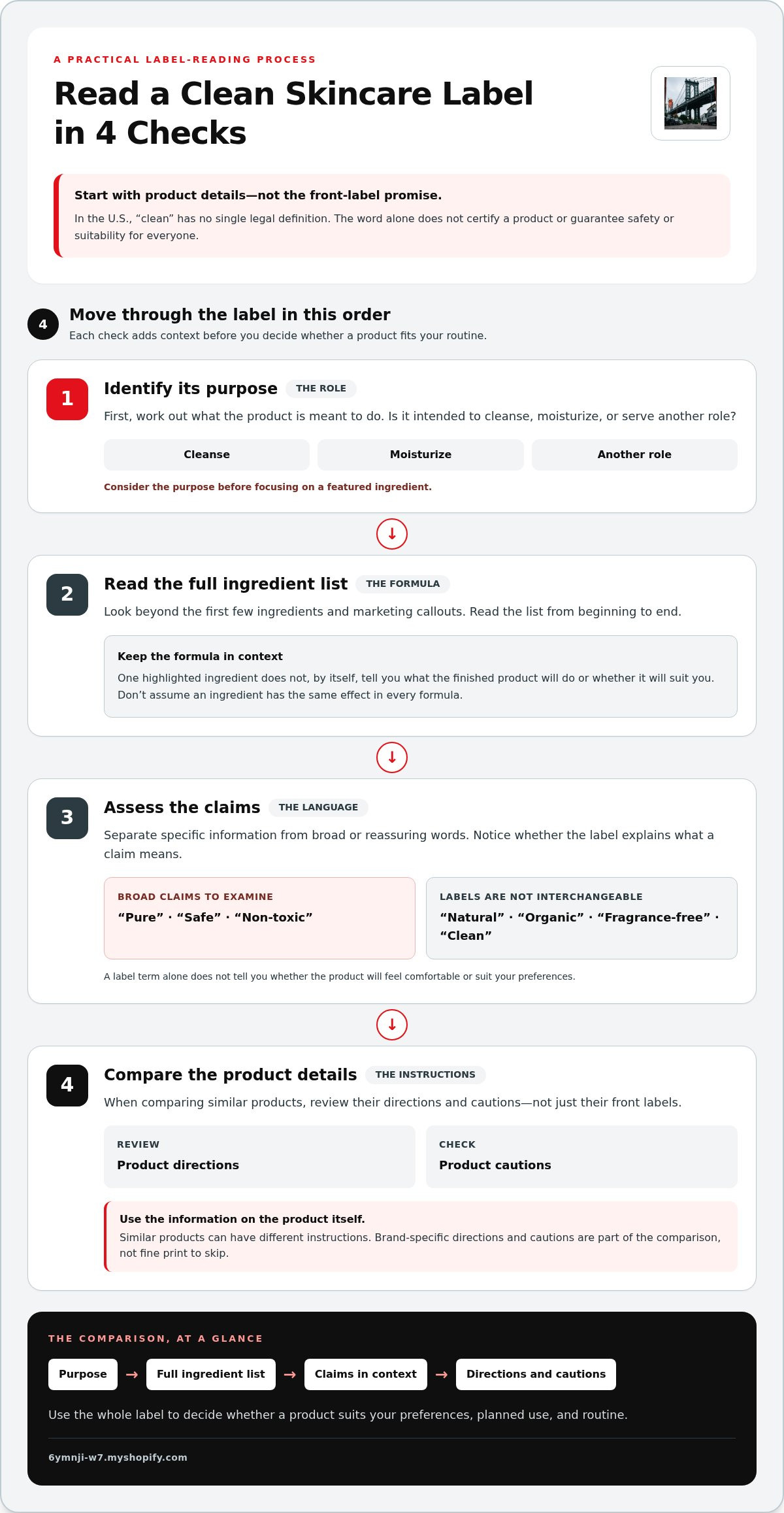
Use this sequence when comparing a product:
- Identify its purpose. Is it intended to cleanse, moisturize, or serve another role? Consider that purpose before focusing on a featured ingredient.
- Read the full ingredient list. Look beyond the first few ingredients and marketing callouts. One ingredient’s presence doesn’t, by itself, tell you what the finished product will do or whether it will suit you.
- Assess the claims. Separate specific information from broad words like “pure,” “safe,” or “non-toxic.” Notice whether the label explains what a claim means.
- Compare the details. Review directions and cautions for each product. Similar products can have different instructions, so use the information on the product itself.
Check the full ingredient list and the product’s stated purpose
Begin with the product’s stated role and directions, then read its ingredient list from beginning to end. Don’t draw conclusions from one highlighted ingredient or assume it has the same effect in every formula. When comparing similar products, place their full ingredient lists and instructions side by side. Brand-specific directions and cautions are part of the comparison, not fine print to skip.
Separate useful transparency from unsupported clean claims
Specific ingredient disclosure gives you something concrete to review. Broad claims such as “pure,” “safe,” or “non-toxic” need more context. “Natural,” “organic,” “fragrance-free,” and “clean” aren’t interchangeable labels, so don’t assume one automatically means another. For additional ingredient context, you can consult EWG's Skin Deep® Cosmetics Database, while keeping the product’s own label and directions in view.
If you try something new, follow its label directions, including any patch-test guidance. A cautious patch test may help you observe how your skin responds, but it can’t guarantee how the product will feel with continued use. Introduce one new product at a time when practical. That makes it easier to notice a response and decide whether the product fits your routine.
Once you know which product role you’re looking for, browse skincare options and use these label-reading steps to compare them. Let clear details guide your choice, not a single claim on the front of the package.
Compare skincare essentials by role, not by routine length
A longer routine isn’t automatically a more considered one. Compare each product by the job it’s meant to do, then decide whether that job matters to you. The table offers a starting point, not a required order or shopping list. Your preferences, the product directions, and your own response all shape whether a category earns space in your routine.
Core routine roles: cleansing and moisturizing
A cleanser is generally used to wash the skin. A moisturizer is intended to add a moisturizing step to your routine. These are common roles, not universal instructions. Texture and directions can influence whether a product feels practical for your habits. If hydration is the main question guiding your search, this simple guide to hydrating skincare products offers more context.
| Product role | When you might consider it | Question to ask before buying |
|---|---|---|
| Cleanser | You want a product with a cleansing role in your routine. | Do its directions and intended use fit the way I plan to use it? |
| Moisturizer | You want a moisturizing step, and its texture and directions appeal to you. | Does this feel like a useful addition to my routine? |
| Targeted treatment | You have a distinct reason to consider a product in this category. | Can I name the specific purpose I want this step to serve? |
| Optional categories | You’re considering a serum, exfoliator, mask, or eye product for a particular preference or need. | Does this add a separate role, or repeat one I already have? |
Look for overlap. Two products may come in different packaging or sit in different categories while serving a similar place in your routine. If you can’t explain what the second one adds, it may be an unnecessary step for now. This doesn’t mean avoiding products that share a broad category. It means comparing their intended roles and directions before deciding whether both have a place.
Optional categories: decide what earns a place
Serums, exfoliators, masks, and eye products are options, not automatic essentials. A toner isn’t a required step for everyone, and adding several treatment products can make a routine longer without clarifying its purpose. Before choosing one, consider the distinct role you want it to fill and whether its directions suit your habits.
Use the table to narrow your choices, not to fill every row. The clean skincare essentials you select can stay simple: each product should have a clear role that makes sense for you. If a category doesn’t meet that test, leave it off your list for now.
Choose clean skincare essentials that fit your needs and habits
A thoughtful shortlist starts with your real routine, not a trend or an idealized shelf. Think about what you want a product to do, when you would use it, and which details matter to you. This keeps clean skincare essentials grounded in your day-to-day preferences rather than a promise on the packaging.
Match a product to your routine and preferences
Before adding a product, name its purpose and where it would fit in your day. Then compare its texture, directions, and ingredient information with what you already use and prefer. A product may sound appealing, but if its directions don’t suit your habits or its texture isn’t comfortable for you, it may be difficult to make space for it.
Use this checklist as you compare:
- Current routine: What do you already use, and what role feels unaddressed?
- Purpose: What do you want this product category to contribute?
- Texture: Does the described feel suit your preferences?
- Directions: Can you follow the product’s instructions as part of your usual day?
- Ingredient sensitivities: Is there ingredient information you want to review based on your own experience?
Keep the choice personal without trying to diagnose a skin condition or find a treatment through general shopping advice. Product descriptions can help you compare the available details, but they can’t predict exactly how your skin will respond.
Keep the shortlist focused as you compare
Put options side by side and compare the same details each time: intended role, full ingredient information, directions, and texture. Remove products that repeat a function unless you have a distinct reason to consider both. A popular ingredient or trending category isn’t, by itself, a reason to add another step.
Introduce one product at a time. Starting several new items together can make it harder to tell which one may be affecting your experience. Adding a single new product, then observing your response, gives you a clearer basis for deciding whether it fits. Follow its label directions and cautions. If you notice discomfort, stop using the product; for persistent concerns, seek guidance from a qualified professional.
It’s easy to assume that “natural” means suitable, or that a trend must be useful because it’s widely discussed. Neither assumption replaces checking the product’s details against your own preferences. The same goes for buying multiple products that appear to serve the same purpose. A shorter shortlist can be more useful when each choice has a reason.
Choose each item for a clear role and a comfortable place in your routine. Keep that principle in mind as you compare, and set aside products that don’t feel like a fit. Browse the skincare selection with your checklist in mind, focusing on function, directions, and the details that matter to you.
Explore My Big Market’s clean skincare collections
A clear, role-based checklist can make browsing more focused. Keep the purpose you’re looking for in mind, then use collection names as starting points rather than promises about a product’s contents or performance. My Big Market’s collections provide several ways to explore clean skincare essentials, including The skincare standard, The hydration collection, and Bundles.
Browse by the kind of support you are seeking
If you’re exploring hydration-focused skincare, start with The hydration collection. Think about the role you want a product to play, then review the information provided for each item. The collection name offers a useful direction, while the product details help you understand an individual item.
The skincare standard is another collection to explore. Use it as a browsing destination, then consider each product on its own terms. A collection name doesn’t tell you the formula, ingredients, or intended results of every item within it.
This approach keeps your search grounded. A category can help narrow where you look, while your shortlist helps you decide what merits a closer read. You don’t need to explore every category at once. Start with the purpose you’ve already identified and browse from there.
Consider bundles when you want a simpler shopping path
Bundles offer another way to browse. Treat them as a shopping category, not as a guaranteed routine or a personalized set. The products included may have distinct roles, so review the individual product pages to understand what’s included and read each item’s directions before deciding whether the set fits your needs.
A bundle can make it easier to consider more than one product together, but it doesn’t remove the need to assess each one. Compare the products’ roles with your current routine. If an included item doesn’t have a clear place or purpose for you, take that into account as you choose.
Keep your process simple: choose a collection that matches the kind of skincare you want to explore, then review the details of individual products. The collection gives you a starting point. Your routine and preferences shape what comes next.
Ready to put your checklist to use? Browse the skincare collection and explore the options at your own pace.
Make your next skincare choice with intention
Your routine can change over time. Preferences shift, habits settle, and a product that once felt useful may no longer have a place. You don’t need to rebuild everything at once. Keep a short note of what you’re looking for, what you already use, and what you’d like to compare next. That small pause can make browsing more considered.
Let clean skincare essentials be a personal shortlist, not a standard you have to meet. Choose at a comfortable pace, and give each new addition room to fit into everyday life. My Big Market focuses on simpler routines and clean, caring ingredients, with collections that make browsing more direct.
When you’re ready to explore, browse My Big Market’s skincare collection and take the next step at your own pace. A thoughtful routine begins with one choice that feels right for you.
Frequently Asked Questions
Does clean skincare have an official definition?
No. In the United States, “clean skincare” isn’t one universal regulatory category, and brands may use the term differently. The label alone can’t tell you whether a product is safe, natural, or effective for you. Instead, compare the full ingredient disclosure and directions, then look for specific explanations behind its claims. That gives you more useful information than treating “clean” as a guarantee.
Can clean skincare still irritate sensitive skin?
Yes. A product may not suit every person, whatever its clean or natural positioning. If you’re sensitive to a particular ingredient, review the full list rather than relying on a front-label claim. Follow the product’s directions and try it cautiously as instructed. Avoid introducing several unfamiliar products at once, so it’s easier to notice what may be associated with a response. For persistent or concerning skin responses, seek qualified professional advice.
Is natural skincare always better than synthetic skincare?
No. “Natural” and “synthetic” describe ingredient origins, not a simple ranking of quality or suitability. A product’s full formulation, intended use, directions, and your preferences all matter. For example, when comparing two moisturizers, consider their stated purposes and directions rather than choosing based only on one ingredient’s origin. Broad labels can’t predict how a particular product will fit your routine or preferences.
Do I need a toner in a simple skincare routine?
No. A toner is a product category, not a required step for every routine. Consider one if its stated purpose interests you and it fits alongside the products you already use. If you can’t identify what role it would add, you may prefer to leave it off your shortlist. If you choose one, read and follow its directions rather than assuming all toners are used in the same way.
How can I introduce a new skincare product carefully?
Read the product’s directions and cautions first, then introduce one new item at a time. This gives you a clearer sense of how you respond, though it can’t guarantee a particular result. If the label provides patch-test guidance, follow it. Keep track of when you start using the product and any notable changes. Stop using it if you have a concerning reaction, and seek qualified professional advice when needed.
Are skincare bundles a good choice for a simple routine?
They can be convenient to browse, but whether a bundle suits you depends on what it contains. Review each product’s name, directions, and ingredient information on its product page. Then consider whether every item has a distinct place in your routine. A bundle isn’t automatically a personalized set or a simpler routine; it’s one shopping option to compare with your needs and preferences.